


Abstract:
Functioning labels such as “high-functioning,” “low-functioning,” and terms like “profound autism” impose external judgments that often deny Autistic people access to support, undermine autonomy, and distort how our needs are understood. Autistic advocacy and research show these labels are harmful and inadequate, and that naming specific support needs is a more just and respectful way forward.
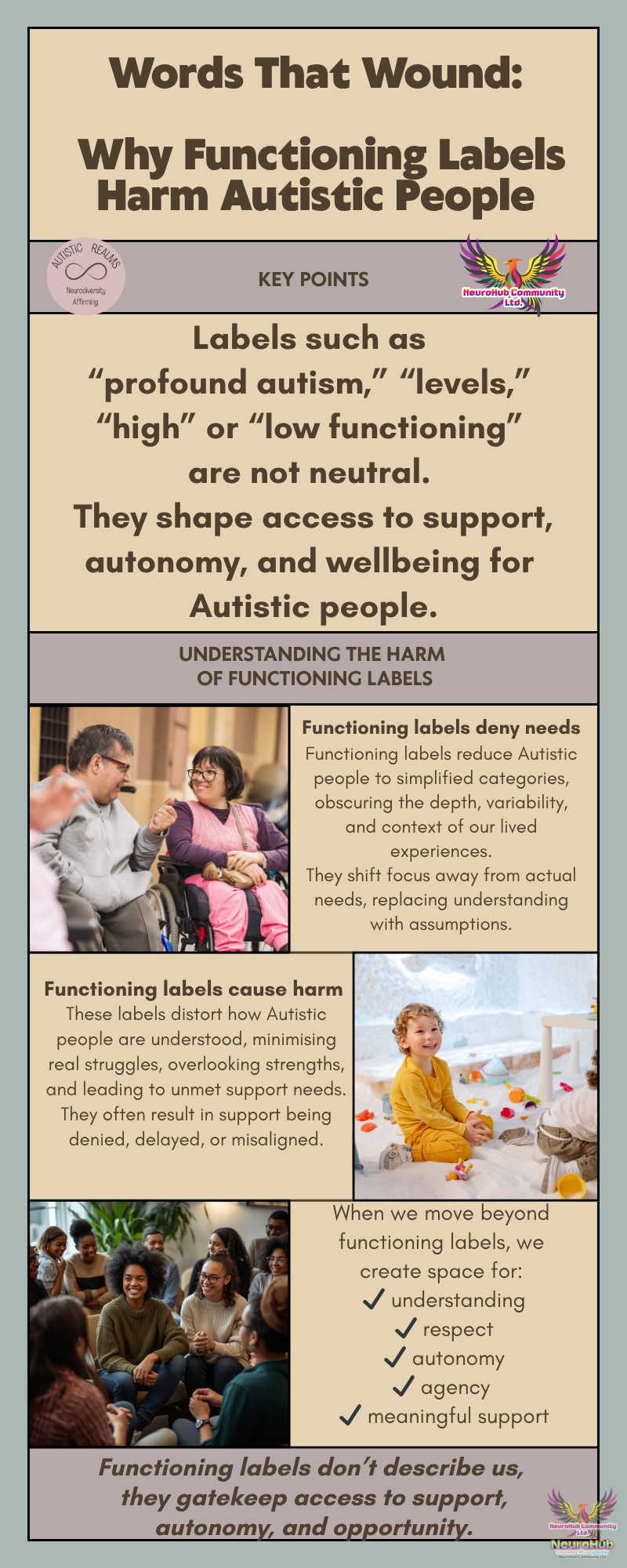
During Autism Awareness and Acceptance Month, there is often a focus on learning about autism and being more inclusive of Autistic people. However, real support goes beyond awareness or acceptance alone. The words we use matter, and functioning labels can shape access to support, autonomy, and belonging in ways that directly affect Autistic people’s mental health and well-being. Functioning labels don’t describe us; they gatekeep access to support, autonomy, and opportunity. This blog, written for the NeuroHub Community Journal is an invitation to look more closely at those labels and to consider what it means to truly support Autistic people.
Functioning labels don’t describe us; they organise access to support, autonomy, and power. They are often used to justify the denial of support to those seen as “high functioning,” while restricting autonomy for those seen as “low functioning”. Functioning labels were never designed to support Autistic people, they were designed to make Autistic people legible to systems and have power over us.
If you are Autistic and have ever been described as “high-functioning” or heard someone you love described as having “Profound Autism”, you will know these words do not sit lightly. They shape how people see us, how much support we are offered, and what others believe we are capable of.
Functioning labels are not descriptive tools; they are used within systems of sorting people into categories. They reduce Autistic people to how closely we approximate neuronormativity, and in doing so, they shape who is believed, who is supported, and who is denied, who is heard and who is silenced. They are words that cause wounds.
They are used to justify withholding accommodations from those seen as “too able,” while simultaneously stripping autonomy from those seen as “too disabled.” They do not protect us; they position us and cause harm. There is no accurate version of a functioning label, only different ways of being misunderstood. Functioning labels are not only inaccurate, they are also harmful (Autistic Self Advocacy Network, 2021; Finn Gardiner, 2018).
What Are Functioning Labels?
Functioning labels such as “high-functioning,” “low-functioning,” “mild,” “severe,” or describing Autistic people in terms of “levels,” are shorthand categories often imposed by those researching on us or writing about us. They classify Autistic people based on our perceived outward behaviour and how closely we align with normative expectations, rather than reflecting our lived experience or actual support needs.
As Gardiner (2018) explains, the same person may be labelled “high-functioning” or “low-functioning” depending entirely on what someone chooses to notice and the context in which they are. These labels do not describe who we are; they reflect what others value, expect, or find acceptable. Autistic advocacy-led spaces have long argued that functioning labels operate as compliance-based judgments, measuring how well an Autistic person performs according to neuronormative expectations rather than recognising our actual strengths and needs.
A False Binary With Harmful Consequences
Functioning labels create a false binary that Autistic people are forced to live inside, either being “not disabled enough” to deserve support or “too disabled” to be trusted with autonomy and our voices are silenced.
There is no safe side of that divide; these labels operate as gatekeeping mechanisms, determining who is granted support, whose needs are taken seriously, and whose autonomy is respected (Autistic Self Advocacy Network, 2021; Stop ABA, Support Autistics, 2019).
Many people labelled “high-functioning” are only seen that way because they may be masking, often at high cost to their mental health, identity, and long-term well-being. Their struggles are minimised, their needs dismissed, and support withheld because they appear to be coping. This might look like an Autistic professional who is praised for performing well at work, yet denied reasonable adjustments, expected to sustain that level of output without support, and eventually reaching burnout, often told they were “fine” until they are no longer able to keep going and then have to suffer the consequences.
At the same time, those labelled “low-functioning,” “severe,” or described as having “profound autism” often experience the opposite harm: their autonomy is reduced, their voices sidelined, and their capabilities may be underestimated. This might look like a non-speaking Autistic person whose understanding is not seen because they do not use spoken language; decisions can be made about their life without their input, despite their ability to potentially communicate in other ways when given the right support.
For people with profound and multiple learning disabilities and other medical or significant health care needs, the harm can be even more significant. Communication may be more subtle, embodied, and relational, expressed through movement, affect, or interaction, and easily overlooked when support is not attuned. Presuming competence, in this context, is not about expecting performance, but about recognising personhood and providing the support needed for that to be expressed, as I have recently described in my blog about Intensive Interaction.
Alvares et al. (2019) found that IQ tests are often used as the basis for “high-functioning” labels, and that these labels are poor predictors of how Autistic people often have to balance and juggle their fluctuating capacity and sensory needs through the day. Many Autistic people without intellectual disability still experience significant challenges in daily living, demonstrating that these labels are fundamentally unreliable and unhelpful.
Kapp (2023) further argues that severity scales and terms such as “profound autism” risk reinforcing these same problems. Non or minimally speaking Autistic people may communicate meaningfully when provided with appropriate support, yet are frequently underestimated or overlooked by standardised assessments. Standardised assessments often measure how well someone can perform under narrow conditions, not what they understand, experience, or are capable of in the right environment.
This is not just a problem of outdated language; it is structural. These labels shape how support, recognition, and rights are distributed. Dignity and autonomy are not achieved by lowering expectations or imposing unrealistic ones, but by deeply understanding each individual’s communication style, meeting their sensory needs, and building responsive, relational support with each person.
It is not labels but the presence or absence of understanding, support, and respect that determines whether autonomy is upheld or denied for Autistic people. Functioning labels not only misrepresent us, they actively shape what happens to us and harm us.
Beyond Fixed Categories: Why Autistic Lives Cannot Be Reduced to Labels
One of the deepest problems with functioning labels is that they treat being Autistic as a fixed, stable state, a set of traits that can be observed, measured, and ticked off.
Being Autistic is not a static way of being, it is dynamic, fluid and context-dependent. Our needs shift across environments, relationships, and our lifespan. Burnout, sensory overwhelm, other co-occurring physical and mental health needs and other life circumstances all shape how much support we need at any given moment. From a monotropic perspective, functioning labels flatten the depth of attention, energy, and experience into static categories that cannot reflect how we actually move through the world, how our attention flows, how it becomes overloaded, and how it is sustained or supported.
This fluidity is also shaped by intersectionality and race, gender, class, sexuality, communication style, and access to resources, all of which influence how Autistic people are perceived, supported, or dismissed. The same person may be read as “coping” in one context and “struggling” in another, not because they have changed, but because the environment, expectations, and biases around them have.
A label applied in childhood cannot predict a person’s needs later in life. Many people who were denied support because they appeared “high-functioning” later often reach burnout, and their mental health is affected. Others, labelled “low-functioning,” may develop new forms of communication, connection, and autonomy when given the right conditions and support and some people may need ongoing support for all aspects of daily living.
Terms such as “profound autism,” “high functioning,” or “levels of autism” do not resolve this problem. They maintain systems of categorisation and segregation that prioritise some needs over others, without addressing the structural changes required to support all Autistic people.
From Labels to Support
The goal is not to replace one label with another, but to move toward clarity, specificity, and respect. Access to support is not something that should be earned through appearing “disabled enough”; it is a human right.
As organisations such as Autistic Self Advocacy Network (2021) emphasise, the most meaningful alternative is to: Describe what someone actually needs. This might look like:
“[Name] uses AAC to communicate and benefits from extra processing time”
“[Name] needs support with executive function, transitions, and sensory regulation”
“[Name] is Autistic and has a co-occurring intellectual disability”
This shift is about more than language; it is about how we understand Autistic people and competence itself. David Gray-Hammond’s and Tanya Adkin’s framing of neurodivergence competence (2023) invites us to move away from judging Autistic people by how closely we meet normative expectations, and toward recognising how competence emerges when the right supports, environments, and relationships are in place. What is often interpreted as inability or overwhelm is frequently a reflection of unmet needs, inaccessible environments, or misattuned expectations.
What we often call “ability” is not a fixed trait, it is something that emerges in context. From an ecosystemic perspective, as explored through my work with David Gray-Hammond in our NeuroHub Community, support does not sit within the individual alone, it exists across systems, in relationships, environments and structures. When these systems are responsive and attuned, Autistic people are better able to access, express, and sustain their strengths. When they are not, what is often labelled as a lack of ability or “challenging behaviour” is more accurately a lack of support.
Functioning labels fail, not just descriptively, but relationally, systemically and structurally. They locate difficulty and failure within the person, rather than within the interaction between the person and their environment, shaping not only how someone is understood, but how their autonomy and agency are recognised or denied.
When we begin instead with listening, with tuning in, building understanding, connection, and meaningful relationships, we create the conditions in which Autistic ways of being, monotropic attention, and different communication and sensory needs can be recognised and supported, rather than misunderstood or dismissed.
Within this, autonomy and agency are not abstract ideals; they are lived through everyday interactions. They are expressed through supported communication, through having choices respected, and through being included in decisions that affect our lives. Consent is part of this, not as a one-off act, but as an ongoing, relational process that requires time, trust, and appropriate support.
Instead of generalising through inaccurate labels, we need to name and respond to specific needs through adjustments, accommodations, and support that enable people to be understood, valued, and believed so everyone can truly thrive and live the life they deserve.
A Note to Our Community
During Autism Awareness and Acceptance Month, there is often a focus on understanding, inclusion, and celebrating Autistic people. But awareness and acceptance alone are not enough if the language and systems around us continue to cause harm. Supporting Autistic mental health and wellbeing requires more than recognition; it requires change.
Functioning labels shape how Autistic people are seen and treated. They can deny access to support, restrict autonomy, and contribute to mental ill health, exclusion, and misunderstanding. If we are serious about the wellbeing of Autistic people, we must be willing to question the frameworks that quietly sustain these harms.
Your worth, your capacity, and your future are not defined by how others categorise you. Your strengths and challenges are both real, and both deserve to be understood and supported.
“Do not mourn for us.” — Jim Sinclair (1993)
Autistic people do not need pity. We need understanding, respect, and support that meets us where we are.
If you are a non-Autistic professional, parent/carer or ally supporting an Autistic person, thank you for reading this and being part of the community. The language we all choose, the assumptions we all take time to question, and the ways we all listen and respond with each other matter. Functioning labels don’t describe us; they organise access to support, autonomy, and power.
Community is magic. Community is power. Community is resistance. — Alice Wong (2020)
This piece connects with my wider work at Neurohub Community with David Gray-Hammond, including Re-Storying Autism, our 7-module video course and workbook that deepens this relational, neuro-affirming understanding of supporting Autistic people beyond labels.
Submit your article to the NeuroHub Community Journal by clicking here.
References
Adkin, T., & Gray-Hammond, D. (2023, April 11). Creating autistic suffering: Autistic safety and neurodivergence competency. Neurohub Community. https://neurohubcommunity.org/2023/04/11/creating-autistic-suffering-autistic-safety-and-neurodivergence-competency/
Alvares, G. A., Bebbington, K., Cleary, D., Evans, K., Glasson, E. J., Maybery, M. T., Pillar, S., Uljarević, M., Varcin, K., Wray, J., & Whitehouse, A. J. O. (2019). The misnomer of “high functioning autism”: Intelligence is an imprecise predictor of functional abilities at diagnosis. Autism, 24(1), 221–232. https://journals.sagepub.com/doi/10.1177/1362361319852831
Autistic Self Advocacy Network. (2021). Functioning labels harm autistic people. https://autisticadvocacy.org/2021/12/functioning-labels-harm-autistic-people/
Edgar, H. (2022). Autism is fluid. Autistic Realms. https://autisticrealms.com/autism-is-fluid/
Gardiner, F. (2018). The problems with functioning labels. Thinking Person’s Guide to Autism. https://thinkingautismguide.com/2018/03/finn-gardiner.html
Gray-Hammond, D. (2026, January 2). Understanding Autism: The Ecosystemic Model Of Distress. Neurohub Community. https://neurohubcommunity.org/2026/01/02/autism-ecosystemic-model/
Kapp, S. K. (2023). Profound concerns about “profound autism”: Dangers of severity scales and functioning labels for support needs. Education Sciences, 13(2), 106. https://www.mdpi.com/2227-7102/13/2/106
Stop ABA, Support Autistics. (2019). Rejecting Asperger’s and other functioning labels. https://stopabasupportautistics.home.blog/2019/09/15/rejecting-aspergers-and-other-functioning-labels/
Sinclair, J. (1993). Don’t mourn for us. Our Voice: The Autism Network International Newsletter, 1(3). https://www.autreat.com/dont_mourn.html
Wong, A. (2020). Disability visibility: First-person stories from the twenty-first century. Vintage.
Further Reading & Signposting
If you would like to explore more advocacy-led perspectives on functioning labels and Autistic experience, check out:
AUsome Training. Functioning labels.
Bristol Autism Support. Why functioning labels are damaging and irrelevant.
Johnson, C. (2017). A label on functionality labels. Just Keep Stimming.
Lincoln Student Life. (2022). Autism functioning labels.
NeuroClastic. Disorder, condition or disability: A look at the fables of autism labels.
Rose, K. (2017). Functioning labels: Why you shouldn’t be using them. The Autistic
Sinclair, J. (1993). Don’t mourn for us. Our Voice: The Autism Network International

Thank you for an excellent article!